
PRODUCTS
Click to view suppliers
SUSPENDED CEILING BOARD SYSTEM
Decorative suspended ceiling tiles could have a variety of characteristics and benefits, such as fire protection, thermal insulation and acoustic properties, reducing unwanted noise whilst contributing to the overall aesthetics of the building internally.
MEMBERS
Disclaimer: “The contents of this website is for information purposes only and no representation is made by TIPSASA regarding the accuracy or suitability of this website for any purpose whatsoever. Users of this website acknowledge that they may rely on the information at their own risk and TIPSASA will not be liable for any loss or damage suffered by a user as a result of such reliance.”

SPRAY FOAM INSULATION
Spray foam insulation is a type of building insulation that can be used in walls, ceilings, crawlspaces and other parts of buildings. The material is mixed on site with special equipment for large applications and should be applied by professionals only. When the foam insulation is sprayed, it coats the surface and quickly expands as it solidifies. It dries quickly, providing insulation that is relatively permanent and will not sag. If the foam expands beyond the desired area, the excess insulation can be trimmed or cut away to the desired size. When the foam is used in the interior of a house, it must be covered with a fire-resistant material, such as drywall.Spray foam insulation is somewhat dangerous to people when it is being sprayed. Particles can get into the eyes, on the skin or breathed in through the mouth and nose if proper safety equipment and clothing are not worn. The chemicals can irritate the eyes and the respiratory system and can cause inflammation or rashes on the skin. It is recommended for a person to wear goggles, a breathing mask, gloves, long sleeves and long pants when spraying foam insulation.
For small applications, single component foam is available in spray cans, for sealing around windows, doors, etc. The foam will act as an air barrier, but not a vapour barrier and should be protected from prolonged exposure to sunlight.
MEMBERS
Disclaimer: “The contents of this website is for information purposes only and no representation is made by TIPSASA regarding the accuracy or suitability of this website for any purpose whatsoever. Users of this website acknowledge that they may rely on the information at their own risk and TIPSASA will not be liable for any loss or damage suffered by a user as a result of such reliance.”
ROOF SYSTEMS & SPACERS
The roof insulation spacer is manufactured from a lightweight high density rigid foam and supplied in standard dimensions as required for the relevant thickness of insulation. By being used as a packer between the insulation and the roof sheet the spacer provides the necessary spacing to allow the insulation to attain maximum installed thickness in the application and significantly reduces backward pressure on the roof sheet or clip system.
MEMBERS
Disclaimer: “The contents of this website is for information purposes only and no representation is made by TIPSASA regarding the accuracy or suitability of this website for any purpose whatsoever. Users of this website acknowledge that they may rely on the information at their own risk and TIPSASA will not be liable for any loss or damage suffered by a user as a result of such reliance.”

ROCK WOOL
Rockwool insulation refers to a type of insulation that is made from actual rocks and minerals. It also goes by the names of stone wool insulation, mineral wool insulation, or slag wool insulation. A wide range of products can be made from rockwool, due to its excellent ability to block sound and heat. This type of insulation is commonly used in building construction, industrial plants, and in automotive applications.
MEMBERS
Disclaimer: “The contents of this website is for information purposes only and no representation is made by TIPSASA regarding the accuracy or suitability of this website for any purpose whatsoever. Users of this website acknowledge that they may rely on the information at their own risk and TIPSASA will not be liable for any loss or damage suffered by a user as a result of such reliance.”

POLYURETHANE
Polyurethane and Polyisocyanurate insulations are manufactured by chemical reactions between poly-alcohols and isocyanurates creating or forming tiny air cells. The cells contain refrigerant gases (fluorocarbons) instead of air. The boards are usually double-faced with foil, or sometimes come bonded with an interior or exterior finishing material. The boards must be protected from prolonged exposure to water and sunlight, and if used on the interior must be covered with a fire-resistant material, such as drywall. Due to the relatively high cost of these insulations, use is generally limited to areas which require a high R-value but where space is very limited.
MEMBERS
Disclaimer: “The contents of this website is for information purposes only and no representation is made by TIPSASA regarding the accuracy or suitability of this website for any purpose whatsoever. Users of this website acknowledge that they may rely on the information at their own risk and TIPSASA will not be liable for any loss or damage suffered by a user as a result of such reliance.”

INSULATED PANELS
Insulated (sandwich) panels comprises of two metal faces and an insulating core. The insulating core is typically bonded to the facings using a conventional adhesive bond.The fire properties of core materials vary significantly. Only non-combustible cores are allowed to be used in: cooking areas, hot areas, bakeries, fire breaks in combustible insulating panels and fire stop insulating panels.
Types of insulating core materials:
- CG (Cellular Glass thermal insulation)
- EPS (Expanded Polystyrene)
- MW (Mineral Wool)
- PIR (Polyisocyanurate)
- PF (Phenolic Foam)
- PUR (Polyurethane)
- XPS (Extruded Polystyrene)
MEMBERS
Disclaimer: “The contents of this website is for information purposes only and no representation is made by TIPSASA regarding the accuracy or suitability of this website for any purpose whatsoever. Users of this website acknowledge that they may rely on the information at their own risk and TIPSASA will not be liable for any loss or damage suffered by a user as a result of such reliance.”

POLYISOCYANURATE
Polyisocyanurate and Polyisocyanurate insulations are manufactured by chemical reactions between poly-alcohols and isocyanurates creating or forming tiny air cells. The cells contain refrigerant gases (fluorocarbons) instead of air. The boards are usually double-faced with foil, or sometimes come bonded with an interior or exterior finishing material.The boards must be protected from prolonged exposure to water and sunlight, and if used on the interior must be covered with a fire-resistant material, such as drywall. Due to the relatively high cost of these insulations, use is generally limited to areas which require a high R-value but where space is very limited.
MEMBERS
Disclaimer: “The contents of this website is for information purposes only and no representation is made by TIPSASA regarding the accuracy or suitability of this website for any purpose whatsoever. Users of this website acknowledge that they may rely on the information at their own risk and TIPSASA will not be liable for any loss or damage suffered by a user as a result of such reliance.”

POLYESTER FIBRE (RIGID BOARD)
A thermally bonded polyester based insulating and acoustic board (50 or 87.5kg/m3 density) used within standard suspended ceiling solutions, over or between purlins, cladding or skimmed ceilings which is also available with foil, vinyl faced or additional acoustic cloth options.
MEMBERS
Disclaimer: “The contents of this website is for information purposes only and no representation is made by TIPSASA regarding the accuracy or suitability of this website for any purpose whatsoever. Users of this website acknowledge that they may rely on the information at their own risk and TIPSASA will not be liable for any loss or damage suffered by a user as a result of such reliance.”

POLYESTER FIBRE (FLEXIBLE BLANKET)
Polyester Fibre made from polyester fibres (including recycled PET bottles) spun into a flexible mat. Available as batts or blankets. Easy to cut and install, non-irritable, with no known physical or health hazards. When exposed to a direct flame the product would melt and shrink away from the flame. Limited operating temperature 150 °C.
MEMBERS
Disclaimer: “The contents of this website is for information purposes only and no representation is made by TIPSASA regarding the accuracy or suitability of this website for any purpose whatsoever. Users of this website acknowledge that they may rely on the information at their own risk and TIPSASA will not be liable for any loss or damage suffered by a user as a result of such reliance.”

PIPE INSULATION
Pipe insulation is a protective covering designed to help maintain an acceptable temperature for pipes and any substance flowing through the pipes. In many instances, pipe insulation also minimizes the impact of the temperature of the pipe on the immediate surroundings.Not only heated pipes are insulated. Jacketed pipes are also used to insulate very cold pipes.
MEMBERS
Disclaimer: “The contents of this website is for information purposes only and no representation is made by TIPSASA regarding the accuracy or suitability of this website for any purpose whatsoever. Users of this website acknowledge that they may rely on the information at their own risk and TIPSASA will not be liable for any loss or damage suffered by a user as a result of such reliance.”

PHENOLIC FOAM INSULATION
Phenolic Foam is manufactured from phenol formaldehyde resin, and is available as either an open or closed cell product. The boards usually come with a foil facing on one or both sides. It is much less combustible than other rigid insulations. It should be protected from prolonged exposure to sunlight and water. It is suitable for wall sheathing, and for use on the interior, both above and below grade. Use is generally limited to areas which require a high R-value, but where space is very limited.
MEMBERS
Disclaimer: “The contents of this website is for information purposes only and no representation is made by TIPSASA regarding the accuracy or suitability of this website for any purpose whatsoever. Users of this website acknowledge that they may rely on the information at their own risk and TIPSASA will not be liable for any loss or damage suffered by a user as a result of such reliance.”

MINERAL WOOL
Mineral Wool (Slag/Rock Wool) manufactured from molten industrial slag, which is fiberized, treated with oil and binders to suppress dust, and maintain shape. It is similar to glass fibre in texture and appearance but denser than glass-wool so R-Value per unit thickness is higher. Rock Wool is manufactured in a similar manner except that natural rock is used instead of slag. These materials have a high fire resistance, limiting operating temperature 850 °C. Generally rock wool is more expensive than glass wool. It can cause eye, skin and respiratory irritation during installation.
MEMBERS
Disclaimer: “The contents of this website is for information purposes only and no representation is made by TIPSASA regarding the accuracy or suitability of this website for any purpose whatsoever. Users of this website acknowledge that they may rely on the information at their own risk and TIPSASA will not be liable for any loss or damage suffered by a user as a result of such reliance.”

HOT INSULATION
Equipment or pipe work with an operating temperature greater than 55 °C in case of metallic surfaces and 65 °C in the case of non-metallic surfaces should be insulated so that the surface temperature after insulation (cold surface temperature) does not exceed 55 °C.It is recognized that temperatures of 60 °C or greater will result in extreme discomfort to personnel and therefore a maximum cold surface temperature of 55 °C should be considered as prudent.
Typical products to be used for applications are calcium Silicate, Ceramic Fibre Blanket, Cellular Glass, Glass Wool, Perlite, Stone Wool, Rock Wool or Vermiculite.
MEMBERS
Electro-Heat Energy
IPC Industries
Insulpro
Kaefer Thermal Contracting Services (Pty) Ltd
Knauf Insulation Ltd
Leytenstone
Masingitaville Solutions
Rockfibre SA (Pty) Ltd
RTM Vacuum & Hydro Jetting (Pty) Ltd
RSC Industrial Services (Pty) Ltd
SGB-Cape
Southey Contracting
TMS Group Industrial Services (Pty) Ltd
Vedder & Moffat
Disclaimer: “The contents of this website is for information purposes only and no representation is made by TIPSASA regarding the accuracy or suitability of this website for any purpose whatsoever. Users of this website acknowledge that they may rely on the information at their own risk and TIPSASA will not be liable for any loss or damage suffered by a user as a result of such reliance.”

GLASS WOOL INSULATION
Manufactured from molten glass spun and formed into mats, rolls and blankets of fine fibres coated with a binding resin. Batts and blankets are light weight, fit standard tie beams and stud spaces, easy to cut and install. Should not be compressed or moistened. Butt all ends and edges together firmly. If installed carefully it will not slump or settle. During installation glass fibre can cause eye, skin and respiratory irritation, and manufacturer’s safety recommendations should be followed. Maximum limited operating temperature 350 °C.
MEMBERS
Disclaimer: “The contents of this website is for information purposes only and no representation is made by TIPSASA regarding the accuracy or suitability of this website for any purpose whatsoever. Users of this website acknowledge that they may rely on the information at their own risk and TIPSASA will not be liable for any loss or damage suffered by a user as a result of such reliance.”

GEYSER INSULATION
The whole essence of fitting a geyser with a geyser blanket is to minimize thermal energy (heat) lost and thereby save energy. Theoretical calculations show that substantial savings can be achieved with the installation of geyser blankets. A Geyser blanket can also consist of an insulating material, assisted by an air gap and an outer reflective coating.
ADDITIONAL ENERGY EFFICIENCY INTERVENTIONS
| APPLICATION | R-VALUE (M2.K/W) |
|---|---|
| Geyser blanket | 1.00 |
| Pipe insulation (heat) | 1.00 |
| Note: As an example, if using bulk insulation, this would equate to ± 40mm fiberglass or 50mm polyester blanket insulation. |
MEMBERS
Disclaimer: “The contents of this website is for information purposes only and no representation is made by TIPSASA regarding the accuracy or suitability of this website for any purpose whatsoever. Users of this website acknowledge that they may rely on the information at their own risk and TIPSASA will not be liable for any loss or damage suffered by a user as a result of such reliance.”

FLOOR INSULATION
Floors do not always require insulation.Raised timber floors should have sub floor access, with soil clearance of around 400mm below the lowest timbers. This provides sufficient access to install insulation. Foil or bulk insulation will work well, but in either case care must be taken to ensure it is well supported and will not sag or fall down in time. Vermin also need to be accounted for. Insulation board can be laid beneath floor finishes if there is no sub floor access.
MEMBERS
Disclaimer: “The contents of this website is for information purposes only and no representation is made by TIPSASA regarding the accuracy or suitability of this website for any purpose whatsoever. Users of this website acknowledge that they may rely on the information at their own risk and TIPSASA will not be liable for any loss or damage suffered by a user as a result of such reliance.”

FIBREGLASS LOOSE WOOL SPRAY-IN
Fiber glass loose-fill insulation is made from molten glass spun or blown into fibers that are then processed into the final product. Fiber glass loose-fill insulation is inorganic and non-combustible. In addition, the fibers will not rot or absorb moisture and do not support the growth of mildew, mould or fungus. Fiber glass loose-fill insulation is available in two forms – either processed from a by-product of manufacturing batts or rolls, or from “prime” fibers produced especially for blowing applications. Both must be applied through pneumatic means using a mechanical blowing machine. Fiber glass loose-fill insulation is designed for “open blow” applications such as attic spaces or closed cavity applications such as those found inside walls or covered attic floors.
MEMBERS
Disclaimer: “The contents of this website is for information purposes only and no representation is made by TIPSASA regarding the accuracy or suitability of this website for any purpose whatsoever. Users of this website acknowledge that they may rely on the information at their own risk and TIPSASA will not be liable for any loss or damage suffered by a user as a result of such reliance.”

EXTRUDED POLYSTYRENE
Extruded Polystyrene is a closed cell polystyrene rigid foam board, with high compressive strength and excellent long term thermal resistance performance, due to its inherent resistance to moisture transfer. It is produced on a continuous, fully automated extrusion process. In South Africa, it is manufactured in a single density range, suitable for most local applications.
Boards are available in various lengths and thicknesses to suit most residential, commercial, agricultural and industrial thermal insulation requirements, including under floor slab, cavity wall, over purlin and rafter, inverted roof and insulated ceiling applications. Polystyrene will deteriorate if continually exposed to ultra violet radiation, and will dissolve in solvents. Compatible with all water-based adhesives and paints.
MEMBERS
Disclaimer: “The contents of this website is for information purposes only and no representation is made by TIPSASA regarding the accuracy or suitability of this website for any purpose whatsoever. Users of this website acknowledge that they may rely on the information at their own risk and TIPSASA will not be liable for any loss or damage suffered by a user as a result of such reliance.”

EXPANDED POLYETHYLENE
Expanded polyethylene is a cellular plastic material very similar to the EPP (Expanded Polypropylene) with a superior flexibility and resistance to repeated impacts. It is a closed cell and cross linked and therefore also waterproof. The elasticity and flexibility is largely retained between -70 and +85 °C
MEMBERS
Disclaimer: “The contents of this website is for information purposes only and no representation is made by TIPSASA regarding the accuracy or suitability of this website for any purpose whatsoever. Users of this website acknowledge that they may rely on the information at their own risk and TIPSASA will not be liable for any loss or damage suffered by a user as a result of such reliance.”

ETICS
ETICS is the abbreviation for External Thermal Insulation Composite System. ETICS can be used to improve the energy efficiency of both new and existing buildings. A comprehensive range is available to meet the various demands of building structure and architecture.ETICS consist of an insulating core, like glass fibre, and the necessary components for fixing to the outside wall with adhesive, anchors or mechanically with rails. After that they are coated with plaster that has been reinforced with woven glass fibre mesh. The final layer consists of the finishing plaster or the desired surface material. ETICS can be used for a great variety of buildings.
MEMBERS
Disclaimer: “The contents of this website is for information purposes only and no representation is made by TIPSASA regarding the accuracy or suitability of this website for any purpose whatsoever. Users of this website acknowledge that they may rely on the information at their own risk and TIPSASA will not be liable for any loss or damage suffered by a user as a result of such reliance.”

DOWN LIGHTERS & ELECTRICAL FITTINGS
DO NOT install insulation over down lighters and transformers.
A Halogen down-lighter reaches 320 °C – Replace Halogen down-light globes with new LED (±80 °C)
IMPORTANT NOTICE: CLEARANCE AROUND APPLIANCES AND FITTINGS!
Care should be taken when installing insulation to ensure that it does not interfere with the safety or performance of domestic services and fittings such as heating flues, recessed light fittings, gas appliances and general plumbing and electrical components. This includes providing appropriate clearance as detailed in relevant legislation and referenced standards such as for electrical, gas and fuel oil installations.
Some appliances and fittings, such as recessed down lights and heater flues, require free space around them for the dissipation of heat, to reduce fire hazard. Insulation should not be placed against these fixtures. Regulations and manufacturers’ recommendations should always be checked before installing insulation.
Allow clearance around appliances and fittings. Electrical wiring must be appropriately installed and should not be covered by insulation or it may overheat.
Unless otherwise specified by manufacturers of insulation;
- Do not install insulation within 90mm of hot flues or exhaust fans, or within 25mm of recessed light fittings.
- Retain a clearance of 90mm for low voltage downlights
Restrain loose-fill insulation with non-combustible barriers.
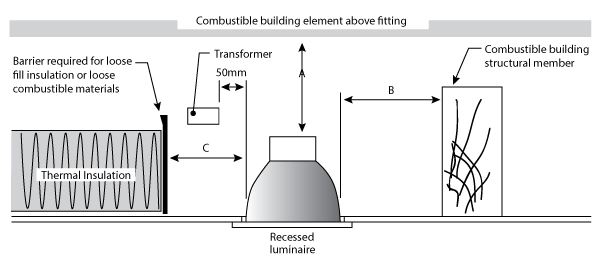
DEFAULT MINIMUM CLEARANCES FOR RECESSED LUMINAIRES
| DIMENSION | INCANDESCENT LAMP | HALOGEN LAMP |
|---|---|---|
| A – clearance above luminaire | 50 mm | 200 mm |
| B – side clearance to structural member | 100 mm | 200 mm |
| C – clearance to thermal insulation | 50 mm | 200 mm |
| D – clearance to supply transformer | 50 mm |
WARNING – DO NOT INSTALL INSULATION OVER DOWN LIGHTERS AND TRANSFORMERS
Disclaimer: “The contents of this website is for information purposes only and no representation is made by TIPSASA regarding the accuracy or suitability of this website for any purpose whatsoever. Users of this website acknowledge that they may rely on the information at their own risk and TIPSASA will not be liable for any loss or damage suffered by a user as a result of such reliance.”

COMPOSITE BULK INSULATION
Composite bulk and reflective materials are available that combine some features of both types. Examples include Foil bonded to bulk insulation, whether blankets, batts or boards, i.e foil faced blankets, foil faced batts and foil faced boards.
MEMBERS
Disclaimer: “The contents of this website is for information purposes only and no representation is made by TIPSASA regarding the accuracy or suitability of this website for any purpose whatsoever. Users of this website acknowledge that they may rely on the information at their own risk and TIPSASA will not be liable for any loss or damage suffered by a user as a result of such reliance.”

COOL ROOF COATINGS
Cool roofs and surfaces reflect and emit the sun’s energy as light back to the sky instead of allowing it to enter buildings as heat. Surfaces such as white roofs and light-coloured pavements reflect solar energy and release stored heat energy.
MEMBERS
Disclaimer: “The contents of this website is for information purposes only and no representation is made by TIPSASA regarding the accuracy or suitability of this website for any purpose whatsoever. Users of this website acknowledge that they may rely on the information at their own risk and TIPSASA will not be liable for any loss or damage suffered by a user as a result of such reliance.”

COLD INSULATION INDUSTRIAL
Cold insulation should be considered, where operating temperatures are below ambient and where protection is required against heat gain, condensation or freezing.In designing an insulation system where formulae and surface coefficients are used they should be to an appropriate international standard, for example, BS 5422 is recommended. In selection of material density, it should be considered whether insulation requires being load bearing or not.
For whatever purpose cold insulation is required, the insulation system is only as good as its vapour barrier and the care with which it is installed.
MEMBERS
BASF South Africa (Pty) Ltd
Electro-Heat Energy
IPC Industries
Insulpro
Kaefer
Thermal Contracting Services (Pty) Ltd
Knauf Insulation Ltd
RSC Industrial Services (Pty) Ltd
RTM Vacuum & Hydro Jetting (Pty) Ltd
SGB Cape
Southey Contracting
TMS Group Industrial Services (Pty) Ltd
Vedder & Moffat
Masingitaville Solutions
Disclaimer: “The contents of this website is for information purposes only and no representation is made by TIPSASA regarding the accuracy or suitability of this website for any purpose whatsoever. Users of this website acknowledge that they may rely on the information at their own risk and TIPSASA will not be liable for any loss or damage suffered by a user as a result of such reliance.”

CAVITY BRICK WALL INSULATION
Brick walls have high thermal mass, but without insulation are usually too cold in winter, and often too hot in summer if exposed to prolonged hot conditions. If a wall cavity is insulated, the internal thermal mass (i.e. the internal brick skin) is protected from external temperature changes, and becomes highly effective at regulating temperatures within the building.External walls should be insulated to reduce radiant, conducted and convected heat transfer.
Wall insulation can be installed:
- Within cavities
- On the inside and outside surface of solid walls
INSULATE EXISTING CAVITIES BY:
- Pumping in loose bulk material to a measured density
- Installing bulk insulation sheets/boards
If using a framed construction system, insulation should be placed within the wall framing. Insulation can also be installed outside the framing (but the insulation must be weatherproof to be effective).
Note that the amount of insulation installed may depend on the thickness of the walls and the size of the framing.
If building a new home or renovation, consider increasing the framing size to fit in more insulation. If using a solid construction system such as concrete, insulation should be placed on the inside of the solid wall within the cavity.
MEMBERS
Disclaimer: “The contents of this website is for information purposes only and no representation is made by TIPSASA regarding the accuracy or suitability of this website for any purpose whatsoever. Users of this website acknowledge that they may rely on the information at their own risk and TIPSASA will not be liable for any loss or damage suffered by a user as a result of such reliance.”

CELLULOSE FIBRE BLOW-IN INSULATION
Cellulose fibre insulation is an environmentally friendly thermal solution, made from finely shredded recycled newsprint which is milled into a light fibrous matrix. The material is treated with inorganic salts to resist fire and fungal growth. The insulation material is pneumatically installed using specialized blowing equipment and due to the small size of the particles, cellulose can flow around obstructions (nails, electrical wires, roof trusses etc.) to give a uniform seamless fill and exceptional “air-tightness”.
MEMBERS
Disclaimer: “The contents of this website is for information purposes only and no representation is made by TIPSASA regarding the accuracy or suitability of this website for any purpose whatsoever. Users of this website acknowledge that they may rely on the information at their own risk and TIPSASA will not be liable for any loss or damage suffered by a user as a result of such reliance.”

CEILING INSULATION
Roofs and ceilings work in conjunction when it comes to insulation. It can save up to 45 percent on heating and cooling energy with roof and ceiling insulation.
Install insulation under the roofing material to reduce radiant heat gain.
Install insulation in the ceiling to reduce heat gain and loss. In most cases ceiling insulation is installed between the joists/trusses directly on the ceiling. Ceilings can be insulated with blown, poured, or blanket/batt-type insulation materials. Fiberglass or polyester blankets may be used and installed on top of ceilings between beams. Cellulose Loose fill is poured or blown into place. Ensure that the ceiling can support the weight of the insulation required. It is possible to add insulation to almost all roof types common in South Africa, and even if some effort is required to lift roofing, the benefit is well worth it. Adding or “retrofitting” insulation to existing buildings provides a major opportunity to increase comfort and reduce energy costs and greenhouse gas emissions.
MEMBERS
Disclaimer: “The contents of this website is for information purposes only and no representation is made by TIPSASA regarding the accuracy or suitability of this website for any purpose whatsoever. Users of this website acknowledge that they may rely on the information at their own risk and TIPSASA will not be liable for any loss or damage suffered by a user as a result of such reliance.”

CEILING 2 IN 1
Certain insulation boards can be retrofitted where there is no insulation to act as a ceiling and insulation (2 in 1) alternatively it could be fitted to the underside of an existing ceiling without the need to remove the old ceiling.
MEMBERS
Disclaimer: “The contents of this website is for information purposes only and no representation is made by TIPSASA regarding the accuracy or suitability of this website for any purpose whatsoever. Users of this website acknowledge that they may rely on the information at their own risk and TIPSASA will not be liable for any loss or damage suffered by a user as a result of such reliance.”

BULK INSULATION
Bulk insulation mainly resists or slows down the transfer of heat by conduction and convection, relying on pockets of trapped air or low conductive gasses within its structure. Its thermal resistance is essentially the same regardless of the direction of heat flow through it. For bulk insulation, R-values are provided for a specific thickness and density of material at a given temperature. The thicker the insulation, the higher the R-value for that product. Bulk insulation includes materials such as glass fibre, slag wool, rock fibre, cellulose fibre, polyester fibre, polystyrene, polyurethane and polyisocyanurate. Each product has a material R-value for a given thickness, density and temperature. The products are available in either a flexible blanket or rigid board.
MEMBERS
Disclaimer: “The contents of this website is for information purposes only and no representation is made by TIPSASA regarding the accuracy or suitability of this website for any purpose whatsoever. Users of this website acknowledge that they may rely on the information at their own risk and TIPSASA will not be liable for any loss or damage suffered by a user as a result of such reliance.”

AIR-CONDITIONING DUCTING INSULATION
In addition to thermal insulation, metal ductwork often requires optimal acoustic insulation to prevent noise transmission and improve comfort.
Duct and pipe distribution networks are essential parts of an HVAC installation. It is critical to install insulation solutions which have a high performance regarding thermal efficiency, fire safety, noise control or indoor air quality.
MEMBERS
Disclaimer: “The contents of this website is for information purposes only and no representation is made by TIPSASA regarding the accuracy or suitability of this website for any purpose whatsoever. Users of this website acknowledge that they may rely on the information at their own risk and TIPSASA will not be liable for any loss or damage suffered by a user as a result of such reliance.”

ACOUSTIC INSULATION
Acoustic insulation is a type of soundproofing that prevent sound from entering or exiting an enclosed space by creating a barrier between the interior and the exterior area. Because sound is able to travel in more than one fashion, the exact process and choice of materials used to manage sound insulation will vary. In some cases, the insulation does effectively reduce sound transmission, but does not completely eliminate the transmission of sounds.
One of the more common approaches to acoustic insulation is the creation of a barrier of some type between the origin of the sound and the surrounding area. The installation of panels on interior walls is one example. With this application, the panels contain foam or other materials that can help to absorb echoing, reverberations, or other types of sound transmissions.
Another option with acoustic insulation involves inserting sound-reducing materials within an existing wall. While this approach does not eliminate sound from penetrating the wall itself, it can usually absorb enough of the sound to minimize the amount that emerges on the opposite side of the wall. This approach is often used in apartment buildings and other areas where people live and work in close proximity.
MEMBERS
Disclaimer: “The contents of this website is for information purposes only and no representation is made by TIPSASA regarding the accuracy or suitability of this website for any purpose whatsoever. Users of this website acknowledge that they may rely on the information at their own risk and TIPSASA will not be liable for any loss or damage suffered by a user as a result of such reliance.”

REFLECTIVE FOIL LAMINATES
Reflective insulation mainly resists radiant heat flow due to its high reflectivity and low emissivity (ability to re-radiate heat). It relies on the presence of an air layer (gap) of at least 25mm next to the shiny surface. The insulation is installed across the rafters before the brandering is nailed down, thus providing the air gap. The thermal resistance of reflective insulation varies with the direction of heat flow through it. Reflective insulation is usually shiny aluminium foil laminated onto paper or plastic and is available in rolls. These products are known as reflective foil laminates (RFL). A layer of reflective foil insulation is an effective membrane and barrier to radiant heat and as a condensation barrier. For optimum energy savings install in conjunction with conventional bulk insulation.
MEMBERS
Disclaimer: “The contents of this website is for information purposes only and no representation is made by TIPSASA regarding the accuracy or suitability of this website for any purpose whatsoever. Users of this website acknowledge that they may rely on the information at their own risk and TIPSASA will not be liable for any loss or damage suffered by a user as a result of such reliance.”

RADIANT BARRIERS
Radiant Heat Barriers/Reflective Foil Membranes reduce heat transfer through radiation.A layer of Reflective Foil Insulation/Radiant Heat barrier is an effective barrier against radiant heat transfer and also as a vapour barrier. Reflective Foil Insulation also offers excellent insulation, performance for downward heat flow (summer heat gain), but only moderate performance for upward or horizontal heat flow (slowing heat losses in winter) and requires an airspace of at least a 25mm between the foil surface and the solid surface to achieve the full insulation qualities. For optimum energy savings install in conjunction with conventional bulk insulation.
MEMBERS
Disclaimer: “The contents of this website is for information purposes only and no representation is made by TIPSASA regarding the accuracy or suitability of this website for any purpose whatsoever. Users of this website acknowledge that they may rely on the information at their own risk and TIPSASA will not be liable for any loss or damage suffered by a user as a result of such reliance.”

VAPOUR BARRIERS
Provide vapour and moisture barriers to prevent condensation. Vapour barriers include polythene sheet, reflective foil, foil backed plasterboard and well maintained water resistant painted surfaces. Water resistant insulation such as polystyrene can also act as a vapour barrier. Tape or glue all joints in vapour barriers to keep out moisture and ensure that there are no tears or pinholes or damage in the membrane.Use vapour barriers to protect from condensation:
- In hot humid (tropical) climates.
- In cool climates where the difference between indoor and outdoor temperature is significant.
- In roof spaces with a low ventilation rate, for example cathedral or raked ceilings.
- In situations where high amounts of vapour are generated and not exhausted.
- On the underside of metal roofing, to minimise the likelihood of corrosion, surface mould, decay of wood based materials, hydration of plastics, etc.
In cold climates place the vapour barrier on the inside of the insulation (directly above the ceiling lining and next to the internal wall lining).
In warm climates place the vapour barrier on the outside of the insulation. In hot humid climates it is ideal to have bulk insulation with a double sided vapour barrier. The top vapour barrier can be installed on site.
Note: The above is a very wide rule of thumb approach and a general design guide, for more critical design each application must be considered on its own merits and may require professional advice input.
Use perforated reflective foil in walls and under mezzanine floors when building with porous materials. The perforations prevent water droplets from penetrating but allow vapour through so that the insulation can dry if it does somehow get wet. This prevents rotting behind weatherboards or under timber floors, for example.
MEMBERS
Disclaimer: “The contents of this website is for information purposes only and no representation is made by TIPSASA regarding the accuracy or suitability of this website for any purpose whatsoever. Users of this website acknowledge that they may rely on the information at their own risk and TIPSASA will not be liable for any loss or damage suffered by a user as a result of such reliance.”

EXPANDED POLYSTYRENE
Expanded Polystyrene is produced by expanding polystyrene beads, which are then bonded together to form rigid boards. “Bead Board” as it is often called is manufactured in two densities. The high density board is more moisture resistant and can be used on the exterior of a foundation, providing the surrounding soil is dry and sandy. Polystyrene will “break down” if left exposed to sunlight for prolonged periods. It must also be protected from solvents and only compatible adhesive & sealants should be used.
MEMBERS
Disclaimer: “The contents of this website is for information purposes only and no representation is made by TIPSASA regarding the accuracy or suitability of this website for any purpose whatsoever. Users of this website acknowledge that they may rely on the information at their own risk and TIPSASA will not be liable for any loss or damage suffered by a user as a result of such reliance.”


